
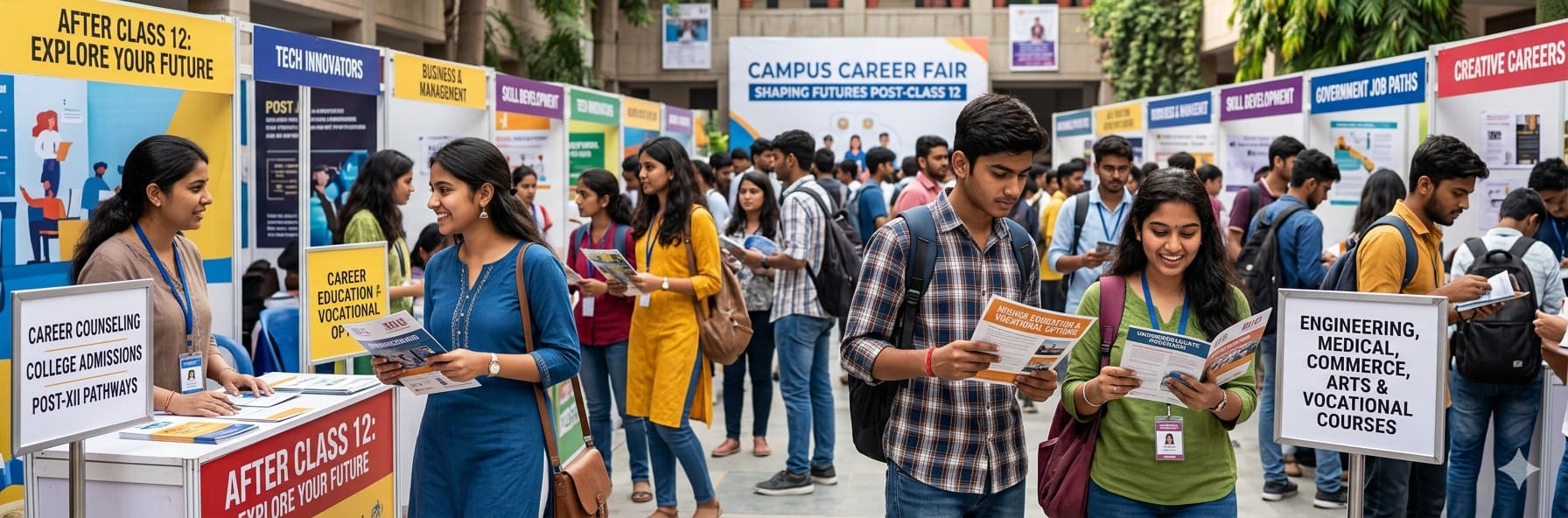
For a long time, the question after 12th boiled down to a short list: engineering, medicine, or “something else” — said quietly, like a consolation prize. That list made sense in a world where job titles stayed roughly the same for thirty years. It doesn’t make as much sense now.
The honest question in 2026 isn’t “which degree gets me the safest job.” It’s “which combination of skill, credential, and adaptability will still be worth something in ten years, when the job itself may have changed shape twice.” That’s a different — and genuinely more answerable — question. Let’s work through it properly.
Outline
Why “AI-driven economy” isn’t just a buzzword here
It’s tempting to roll your eyes at “AI is changing everything” — it’s become wallpaper noise. But for a 12th-pass student making a multi-year decision, the actual numbers are worth sitting with.
Global research on this — most notably the World Economic Forum’s Future of Jobs work — projects that automation and AI will displace tens of millions of roles by 2030, while creating an even larger number of new ones, for a healthy net gain in jobs overall. The catch: the people losing roles aren’t automatically the ones filling the new ones. That gap is the real story, and it’s a skills gap, not a jobs gap.
Separately, research from PwC’s analysis of AI’s effect on hiring found something genuinely useful for career planning: jobs that AI “professionalizes” — meaning AI takes over the routine parts and leaves the judgment-heavy parts to humans — are growing roughly twice as fast in pay and headcount as jobs AI simply “makes easier for anyone to do.” In plainer terms: pick paths where your value increasingly comes from judgment, not just task execution, and you’re betting on the stronger trend.
This doesn’t mean “study AI.” It means: whatever you study, ask how much of that field’s daily work AI can already do, and how much still needs a human making calls under uncertainty.
The traditional route — still strong, just more crowded than it looks
Engineering and medicine remain completely legitimate choices. But “safe” isn’t quite the right word for them anymore — “competitive” is more accurate.
Consider JEE Main: in the 2026 session, roughly 1.3 million candidates competed for around 63,000 seats across the NITs, IIITs, and other centrally funded institutes. That’s not a reason to avoid the path if it’s genuinely your strength — but it is a reason to have a realistic Plan B in your back pocket before results day, not after.
Chartered Accountancy tells a similar story from the commerce side: the CA Intermediate exam’s pass rate in one recent sitting was around 10%. ICAI’s own registration and exam fees are genuinely affordable — roughly ₹50,000–80,000 in total. But most students also take optional coaching classes, which pushes the realistic all-in cost to somewhere between ₹1.5 lakh and ₹3.5 lakh across the full four-to-five-year journey. The stipend you earn during articleship offsets some of that — but “affordable on paper” and “what most people actually spend” are two different numbers, and it’s worth budgeting for the second one.
None of this is a reason to abandon these paths. It’s a reason to walk in with your eyes open, and to have looked seriously at alternatives before you’ve sunk three years into one option with no fallback.
The high-growth degree pathways worth a serious look
If you’re choosing a degree specifically because you want to bet on where demand is heading, a few fields keep showing up at the top of global growth forecasts: data science, AI/machine learning, cybersecurity, renewable energy engineering, and fintech-adjacent roles.
What connects these isn’t just “tech” — cybersecurity and renewable energy engineering aren’t really about coding all day, for instance. What connects them is that they sit at the intersection of a structural, multi-year shift (more data, more automation, the energy transition, digital finance) and a skill humans currently do better than software: judgment under ambiguity, not just pattern repetition.
If you’re a PCM student, this might mean choosing a B.Tech or B.Sc. specialization with deliberate exposure to one of these areas, rather than a generic stream. If you’re commerce or arts-background, fintech, UX/product roles, and policy-adjacent tech work are very real entry points too — these fields are far less PCM-exclusive than they used to be.
The vocational and skill-certification pathway — not a fallback, a parallel track
Here’s the part that gets undersold the most: vocational and certificate-based training is not “what you do if college doesn’t work out.” It’s a legitimate, often faster, often cheaper route into real, current demand.
India’s government-backed skilling ecosystem — built around the National Skill Development Corporation and the Skill India Programme — runs certificate training across healthcare, IT, retail, construction, electronics, hospitality, logistics, and increasingly AI-adjacent and green-technology roles. The program has continued with significant government investment through 2026.
Here’s the opportunity-gap framing worth knowing: only an estimated 5% of Indians aged 20–24 have gone through any formal vocational training, despite roughly 250 million young people projected to enter the workforce in the coming years. That’s not a small gap. For a student who’s genuinely more hands-on than exam-oriented, or who wants to be earning two years sooner than a four-year-degree path allows, this isn’t a consolation prize — it’s an underused door.
A simple framework for actually deciding
With all that on the table, here’s a workable way to narrow it down — useful to walk through together if a parent and student are reading this side by side:
- Interest and aptitude first. What do you keep choosing to do even when no one’s grading you on it? Burnout risk goes up fast in any field you don’t actually enjoy, no matter how “future-proof” it looks on paper.
- Demand signal second. Is this field showing up in growth forecasts, or shrinking? Neither traditional nor new automatically wins this — check both.
- Honest cost and timeline third. What does this path actually cost — in money, in years, in how many attempts a competitive exam realistically takes? Compare that cost against the vocational alternative seriously, not dismissively.
No single answer is “correct” for everyone. The goal is making the trade-offs visible instead of invisible.