
Outline
I. Editorial Foreword: The Architecture of Cognitive Mastery
In today’s education landscape, the greatest obstacle to academic success is no longer access to information but it is learning how to use that information effectively.
Millions of students spend hours rereading textbooks, highlighting passages, and rewriting notes. These habits create the illusion of competence, as researchers call it – the feeling that we understand something simply because it looks familiar. Unfortunately, familiarity is not the same as mastery.
At Class N Study, we advocate a shift from traditional memorization to evidence-based learning – a framework grounded in decades of cognitive science research. Scholars such as Henry L. Roediger III, Jeffrey D. Karpicke, and John Sweller have shown that the most effective study methods are not always the easiest ones.
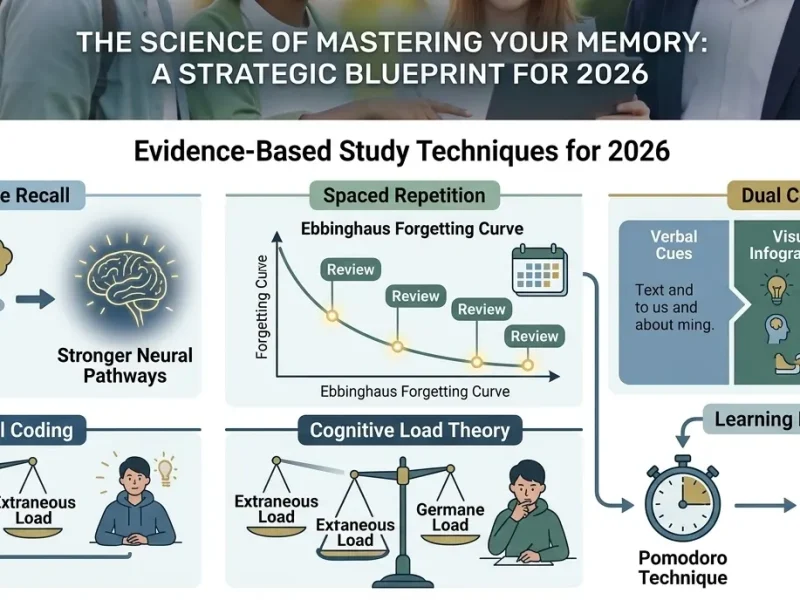
True learning happens through what psychologists call Desirable Difficulties – strategies that challenge the brain enough to strengthen memory and understanding. Techniques such as active recall, spaced repetition, interleaving, and dual coding align with the brain’s natural learning processes and help counter the effects of the Forgetting Curve, first identified by Hermann Ebbinghaus.
This guide explores not only how to study more effectively, but why these methods work. By understanding the science of learning, students can replace inefficient habits with strategies that build lasting knowledge.
Studying is not about working harder, it is about learning smarter.
II. Retrieval Practice: The “Gold Standard” of Learning
Why Retrieval Matters More Than Review
Many students assume that effective studying means repeatedly reading textbooks, reviewing notes, or highlighting key passages. While these methods create a sense of familiarity, cognitive science shows they rarely produce durable learning.
Research in Educational Psychology demonstrates that the most powerful learning occurs when students actively retrieve information from memory rather than simply re-expose themselves to it.
This principle is known as retrieval practice.
A landmark study by Jeffrey D. Karpicke and Henry L. Roediger III published in Science revealed that students who repeatedly tested themselves on material retained far more information over time than those who only reread the same material multiple times.
In their experiment, students who practiced retrieval remembered nearly 50% more information after one week compared with students who relied solely on review-based study techniques.
The implication is clear: learning strengthens when the brain is forced to recall information without assistance.
Why Retrieval Practice Works
Retrieval practice improves learning because it aligns with the brain’s natural memory processes.
1. Strengthens Neural Pathways
When information is retrieved from memory, the brain reactivates neural connections associated with that knowledge. Each successful retrieval strengthens these connections, making the information easier to access later.
Neuroscientists often compare this process to exercising a muscle—the more frequently a memory is retrieved, the stronger and more stable it becomes.
2. Improves Recall Speed and Accuracy
Exams and real-world problem solving require rapid access to stored knowledge. Retrieval practice trains the brain to locate and reconstruct information quickly.
Students who rely only on rereading often recognize material but struggle to recall it independently. Retrieval practice eliminates this gap between recognition and true recall.
3. Identifies Knowledge Gaps
One of the most valuable aspects of retrieval practice is that it immediately reveals what you do not know.
When students attempt to recall information and cannot do so, they discover precisely which areas require further study. This targeted feedback makes studying significantly more efficient.
Practical Retrieval Practice Techniques
Retrieval practice can be implemented through several simple yet powerful methods. These techniques are widely recommended by learning scientists and educational researchers.
1. The Blurting Method
The blurting method is one of the simplest ways to apply retrieval practice.
How it Works
- Read a section of a textbook or study material.
- Close the book or hide the notes.
- Write down everything you can remember about the topic from memory.
- Compare your notes with the original material to identify missing points.
This technique forces the brain to reconstruct knowledge without cues, which strengthens memory consolidation.
Students often discover that they remember far less than they initially believed—a useful insight that helps guide further study.
2. The Feynman Technique
Another powerful retrieval method is the Feynman Technique, named after Nobel Prize–winning physicist Richard Feynman, who was famous for his ability to explain complex scientific ideas in simple language. Feynman believed that true understanding is demonstrated by the ability to teach a concept clearly.
Steps of the Feynman Technique
- Choose a concept you want to understand.
- Explain the concept in simple language, as if teaching it to someone with no prior knowledge.
- Identify gaps in your explanation – these indicate areas where your understanding is incomplete.
- Review the material again and simplify the explanation further.
This process forces learners to organize knowledge logically and remove unnecessary complexity. As a result, understanding becomes deeper and more durable.
3. Active Flashcards
Flashcards are widely used by students, but their effectiveness depends on how they are used. Passive flashcard use, simply flipping through cards, provides little benefit. Effective flashcard learning requires active recall.
Effective Flashcard Strategy
- Look at the question side of the card.
- Attempt to recall the answer fully before flipping the card.
- Say or write the answer from memory.
- Check the card and correct any mistakes.
Digital flashcard systems also allow students to combine retrieval practice with spaced repetition, further strengthening long-term memory.
Popular tools include:
- Anki, which uses an algorithm to schedule reviews at optimal intervals.
- Quizlet, which provides interactive flashcard sets and practice quizzes.
Integrating Retrieval Practice into Daily Study
To gain the full benefits of retrieval practice, students should integrate it into regular study routines.
For example:
- After reading a chapter, write a brief summary from memory.
- Use flashcards to test key definitions or concepts.
- Explain topics aloud as if teaching a classmate.
- Complete practice questions without referring to notes.
Even short retrieval sessions can significantly improve retention over time.
Key Insight
Retrieval practice may feel more difficult than rereading, but this difficulty is precisely what makes it effective. The effort required to reconstruct knowledge strengthens memory and deepens understanding.
As research by Jeffrey D. Karpicke and Henry L. Roediger III demonstrates, students who regularly test themselves are far more likely to retain information weeks or months later.
For this reason, many learning scientists now consider retrieval practice – the most powerful study strategy available to students.
III. Spaced Repetition: Defeating the Forgetting Curve
Why Timing Matters in Learning
One of the most common mistakes students make is concentrating all their study effort into a single intensive session—often the night before an exam. While this cramming strategy may temporarily boost short-term recall, research consistently shows that the knowledge gained fades rapidly.
Spaced repetition offers a far more effective approach.
Spaced repetition is a learning method in which review sessions are distributed across gradually increasing intervals of time. Instead of repeatedly studying the same material in one sitting, learners revisit the information periodically over days or weeks.
This approach directly counters the memory decay described by the Forgetting Curve, first identified by German psychologist Hermann Ebbinghaus. Ebbinghaus discovered that newly learned information fades rapidly unless it is reinforced through timely review.
Spaced repetition interrupts this forgetting process by strengthening memories precisely when they are most vulnerable to fading.
Research Evidence Supporting Spaced Learning
Decades of research in Educational Psychology have confirmed the effectiveness of distributed learning.
A comprehensive meta-analysis conducted by Nicholas J. Cepeda examined hundreds of learning experiments comparing distributed practice (spaced learning) with massed practice (cramming). The results were remarkably consistent: students who reviewed information at spaced intervals retained knowledge significantly longer than those who studied the same material repeatedly in a single session.
Distributed practice not only improves long-term memory retention, but also enhances the brain’s ability to retrieve knowledge during exams and real-world problem-solving situations. In essence, spaced repetition transforms studying from a short-term memorization exercise into a long-term knowledge consolidation process.
Why Spaced Repetition Works
Spaced learning is effective because it takes advantage of how the brain strengthens memory over time.
When students revisit information after a delay:
- the brain must reconstruct the memory, reinforcing neural connections
- the effort required to recall the information creates a desirable level of cognitive difficulty
- each successful retrieval strengthens long-term storage
This process gradually shifts knowledge from fragile short-term memory to durable long-term memory.
As a result, spaced repetition does not merely maintain knowledge – it progressively stabilizes and deepens understanding.
The 2-3-5-7 Review Framework
One practical way to implement spaced repetition is through a structured review schedule. A simple yet effective model is the 2-3-5-7 framework, which spaces review sessions across expanding intervals.
Example Review Schedule
Day 1: Initial Learning
Study and understand the new concept for the first time.
Day 3: First Review (2 days later)
Revisit the material briefly to reinforce initial understanding.
Day 6: Second Review
At this stage, some forgetting has begun. Reviewing now strengthens memory consolidation.
Day 11: Third Review
The longer interval encourages deeper retrieval and stronger memory encoding.
Day 18: Final Reinforcement
By this stage, the information has been revisited several times and is far more likely to remain in long-term memory.
This pattern strategically reinforces knowledge just as the brain begins to forget it, allowing each review session to strengthen memory more effectively.
Integrating Spaced Repetition with Other Study Methods
Spaced repetition becomes even more powerful when combined with other evidence-based learning strategies.
For example:
- reviewing flashcards through spaced intervals using apps such as Anki
- revisiting key concepts using retrieval practice rather than rereading notes
- practicing exam-style questions during each review session
Digital spaced-learning tools can automate this process by calculating optimal review intervals based on how well a learner remembers each item.
Key Insight
The central lesson of spaced repetition is simple: learning is not a one-time event – it is a process of reinforcement over time.
Students who review material strategically over several days or weeks dramatically increase the likelihood that information will remain accessible long after the exam has passed. By aligning study schedules with the brain’s natural memory rhythms, spaced repetition transforms scattered study sessions into a systematic pathway toward long-term mastery.
IV. Interleaving: The Power of Mixed Practice
Why Mixing Topics Improves Learning
Traditional study habits often follow a pattern known as blocked practice – students focus on one topic or type of problem for an extended period before moving on to another. For example, a mathematics student may complete dozens of algebra problems in sequence before switching to geometry or calculus.
While this method can create a temporary sense of fluency, cognitive science suggests that it may limit deeper understanding.
An alternative approach known as interleaving involves mixing different topics or problem types within the same study session. Instead of focusing exclusively on one category of problems, students rotate between related concepts, forcing the brain to continually adjust its approach to solving them. In simple terms, interleaving replaces repetitive practice with varied, mixed practice.
Example of Interleaving in Practice
Consider a student studying mathematics. Under a blocked practice approach, the study session might look like this:
Blocked Practice Example
- 50 algebra problems
In contrast, an interleaved session distributes different types of problems across the same study period:
Interleaved Practice Example
- 15 algebra problems
- 15 geometry problems
- 15 calculus problems
Although the total amount of work remains similar, the learning experience changes significantly. Each time the student switches topics, the brain must determine which strategy or formula is appropriate for the new problem.
This repeated process of identifying and applying the correct method strengthens conceptual understanding.
Research Findings on Interleaving
Research in Educational Psychology has repeatedly demonstrated that interleaving improves learning outcomes across a variety of disciplines. Studies published in the Journal of Educational Psychology show that students who practice mixed problem sets perform significantly better on later tests than students who use blocked practice.
One of the leading researchers in this field, Doug Rohrer, has conducted extensive studies on how interleaving affects mathematics learning. His research indicates that when students encounter different types of problems in an interleaved sequence, they become better at identifying which solution strategy is required.
This ability – sometimes called problem discrimination – is critical for success in exams and real-world problem solving. In contrast, blocked practice often allows students to solve problems mechanically because they already know which method will be required.
Why Interleaving Works
Interleaving improves learning because it introduces productive cognitive challenges.
When students move between different types of problems:
- the brain must analyze each question carefully before selecting a strategy
- learners practice recognizing patterns and differences between concepts
- knowledge becomes more flexible and transferable to new situations
Although interleaving may initially feel more difficult than blocked practice, this difficulty reflects deeper cognitive engagement rather than confusion.
Learning scientists often emphasize that strategies that feel harder during practice frequently produce stronger long-term learning.
Applying Interleaving in Daily Study
Students can incorporate interleaving into their study routines with simple adjustments.
Examples include:
- mixing different types of mathematics problems within a single study session
- alternating between related subjects such as physics and mathematics
- practicing vocabulary, grammar, and reading comprehension together when learning a language
- combining conceptual review with applied problem solving
Even small variations in study order can significantly improve the brain’s ability to recognize patterns, select appropriate strategies, and apply knowledge in unfamiliar situations.
Key Insight
Interleaving teaches the brain not just how to solve a problem, but how to decide which method should be used in the first place.
By exposing learners to varied problem types within the same study session, mixed practice develops a deeper level of conceptual understanding – one that prepares students not only for exams but also for complex problems.
V. Metacognition: Thinking About Your Thinking
The Role of Self-Awareness in Learning
Successful learning is not determined solely by how much time students spend studying, but also by how effectively they monitor and regulate their own understanding. This capacity for self-awareness in learning is known as metacognition.
In the field of Educational Psychology, metacognition refers to the ability to reflect on one’s own thinking processes, evaluate current levels of understanding, and adjust learning strategies accordingly. In simple terms, it involves “thinking about thinking.”
Students who develop strong metacognitive skills are better able to recognize when they truly understand a concept and when they are merely familiar with it. This distinction is crucial, because many learners mistake recognition for mastery – an issue often described as the illusion of competence.
Metacognitive learners, by contrast, continuously assess their progress and make deliberate decisions about what to study next, how to study it, and when additional review is required.
Research Evidence on Metacognitive Learning
Research consistently demonstrates that metacognition plays a central role in academic achievement.
According to studies conducted by the Education Endowment Foundation, strategies that promote metacognition and self-regulated learning can lead to significant improvements in student performance across a wide range of subjects. Their evidence reviews indicate that students who actively reflect on their learning processes often gain several months of additional academic progress compared with peers who do not employ such strategies.
These findings suggest that metacognition is not merely an abstract psychological concept—it is a practical skill that directly influences how efficiently students learn and retain information.
The Provost Strategy: A Practical Framework for Metacognitive Reflection
One effective way to develop metacognitive awareness is through structured self-questioning. This approach is sometimes referred to as the Provost Strategy, a simple reflective framework that encourages learners to evaluate their understanding before, during, and after studying.
Instead of passively reading or memorizing information, students pause periodically to ask themselves a series of guiding questions.
Key Reflective Questions
Students practicing metacognition might regularly ask:
- What do I already know about this topic?
Activating prior knowledge helps the brain connect new information with existing mental frameworks. - Why is this concept difficult for me?
Identifying the specific source of confusion allows learners to address gaps in understanding more effectively. - How does this connect to what I learned previously?
Recognizing relationships between concepts strengthens conceptual networks in long-term memory.
These reflective questions transform studying from a passive activity into an active process of evaluation and adjustment.
Why Metacognition Improves Learning
Metacognitive strategies enhance learning because they promote self-regulated learning – the ability to plan, monitor, and evaluate one’s own study behavior.
When students practice metacognition:
- they become more aware of their strengths and weaknesses
- they allocate study time more strategically
- they select learning techniques that match the demands of the material
- they correct misunderstandings before they become entrenched
Over time, these habits cultivate learners who are not only knowledgeable, but also strategic and independent thinkers.
Applying Metacognitive Strategies in Daily Study
Metacognition can be integrated into nearly any study routine. Students can begin developing this skill by incorporating short reflective pauses throughout their learning sessions.
For example, learners might:
- review their understanding after completing a chapter or lecture
- summarize key ideas in their own words
- evaluate which concepts remain unclear before moving on
- adjust study strategies if comprehension remains weak
These reflective checkpoints encourage students to remain actively engaged with the learning process rather than passively absorbing information.
Key Insight
Metacognition transforms studying from a mechanical routine into an intentional learning strategy. By regularly reflecting on their own understanding, students gain greater control over how they learn and how effectively they retain knowledge.
In this sense, metacognition is not simply another study technique – it is the framework that allows all other learning strategies to work more effectively. Students who master this skill develop the capacity to guide their own intellectual growth long after formal education has ended.
Conclusion: From Passive Studying to Scientific Learning
For decades, students around the world relied on study habits that emphasized repetition, rereading, and last-minute cramming. While these approaches can create a temporary sense of familiarity with the material, modern research in Cognitive Psychology and Learning Sciences has revealed that they rarely produce durable, long-term learning.
Today, a growing body of evidence shows that effective studying is not simply about how long students study, but about how strategically they engage with information. Evidence-based techniques transform studying from a passive routine into an active cognitive process that strengthens understanding, memory, and problem-solving ability.
The techniques discussed in this guide illustrate how scientific research has reshaped the way students can approach learning.
Key strategies include:
- Retrieval practice, which strengthens memory by actively recalling information rather than rereading it
- Spaced repetition, which combats the Forgetting Curve by distributing reviews over time
- Interleaving, which improves the brain’s ability to distinguish between similar concepts through mixed practice
- Metacognition, which enables students to monitor their own understanding and regulate their learning strategies
- Focused study sessions, which encourage sustained concentration and reduce the cognitive costs of distraction
Together, these techniques shift learning away from rote memorization and toward deep conceptual mastery. Instead of merely recognizing information, students begin to build durable mental models that allow them to apply knowledge in new and complex situations.
Educational research consistently demonstrates that learners who adopt such strategies gain a significant academic advantage. By engaging more actively with material, reviewing it at scientifically optimal intervals, and reflecting on their own understanding, students develop stronger retention and greater intellectual independence.
Ultimately, effective studying is not a matter of natural intelligence or innate talent. It is a skill—one that can be systematically improved through methods grounded in research and tested in classrooms around the world.
Students who apply these evidence-based learning strategies are not simply preparing for their next examination. They are building the cognitive tools needed for lifelong learning and sustained academic success.