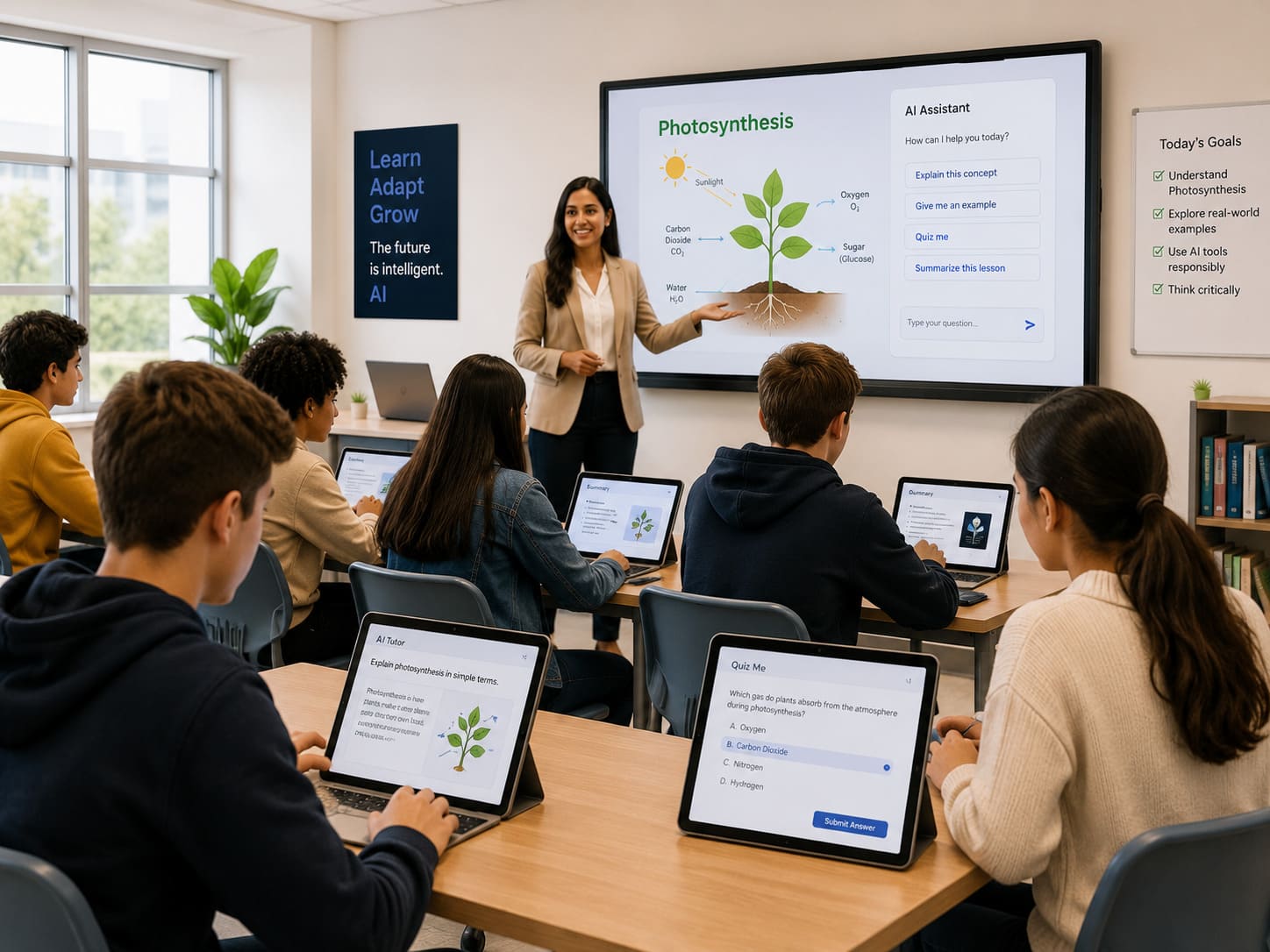
Not long ago, “AI in the classroom” meant a novelty — a chatbot you could ask your homework questions to, or a recommendation algorithm suggesting the next video in a study playlist. That era is over. In 2026, artificial intelligence has moved from the edges of education into its core infrastructure, reshaping how lessons are planned, how students receive feedback, how teachers manage their workload, and — most fundamentally — how learning itself is experienced.
The numbers reflect this shift clearly. Research from Gallup and the Walton Family Foundation found that six in ten US K-12 teachers now use AI tools in their classrooms, with nearly one in three using them every week. A global survey of students conducted in mid-2024 found that 86% reported using AI tools in their schoolwork. On the institutional side, adoption has accelerated sharply: the share of educational institutions with AI integrated into their systems jumped from 49% to 66% in a single year. And market research firms project that the global AI in education sector, valued at around $5.18 billion in 2024, will grow to $112.3 billion by 2034.
What do these figures actually mean for students and teachers on the ground? That’s the question this piece answers — by looking at the real trends reshaping education right now and the specific tools making it happen.
Outline
How AI Is Personalising the Classroom
For most of the history of formal education, the curriculum moved at its own pace, and students adapted — or didn’t. A lesson was the same for every student in the room, whether they found it trivially easy, completely overwhelming, or somewhere in between. The only real feedback loop was the end-of-term exam, by which point the gap between understanding and confusion had often become very large.
Adaptive AI systems are dismantling this model. Instead of a fixed curriculum that every student follows in the same sequence at the same speed, AI-powered platforms analyse each student’s real-time performance — which questions they get right, where they hesitate, which explanations they re-read — and adjust content accordingly. Difficulty increases as mastery builds; when a concept isn’t landing, the system surfaces a different explanation, a simpler worked example, or a foundational concept the student may have skipped. The curriculum reshapes itself around the learner rather than the other way around.
Generative AI adds another layer: the ability to create learning materials on demand. A teacher working with a mixed-ability classroom can generate a reading passage on the same topic at three different reading levels in minutes, each with its own vocabulary list and comprehension questions. A student who finds the standard textbook explanation of a concept confusing can request an alternative explanation framed around their specific interests. What was previously an enormous amount of preparation time collapses into seconds.
The result is that personalised learning is no longer an aspiration — in well-resourced environments, it is becoming the baseline. Crucially, this doesn’t mean AI replaces the teacher. It means teachers are freed from the impossibility of simultaneously serving thirty different learning needs with a single lesson. AI handles the differentiation; teachers handle the relationship and the judgment.
Giving Teachers Their Time Back
Teaching has always involved more than teaching. Lesson planning, rubric creation, grading, IEP documentation, parent communication, attendance tracking, progress reporting — teachers spend a significant portion of their working week on tasks other than direct instruction. Gallup research, conducted in partnership with the Walton Family Foundation in 2025, found that teachers who use AI tools weekly save an average of 5.9 hours per week — the equivalent of roughly six full weeks per school year.
That figure, aggregated across a population of educators, represents something significant: time that can go back into the classroom, toward the work that no AI can replicate — noticing a student who’s disengaged, building the trust that makes feedback land, asking the follow-up question that pushes a class discussion in a direction no algorithm would predict.
This is the practical promise of AI in education for teachers. It isn’t that AI will teach their students for them. It’s that the mountain of low-reward, high-volume administrative work that currently consumes a third or more of an educator’s week can be dramatically reduced. The tools making this possible — which we cover in detail below — handle the repetitive drafting and organisation, so teachers can refocus on what they’re uniquely able to do.
A Personal Tutor for Every Student
One of the oldest inequalities in education is access to individual attention. A student at a well-resourced institution might have access to a personal tutor, office hours with genuinely available professors, and a structured support system for when they fall behind. Most students don’t have any of those things. AI tutoring systems are beginning to change this — imperfectly, but meaningfully.
The most interesting of these systems don’t simply provide answers. They ask questions. Khan Academy’s Khanmigo, for example, is deliberately built around a Socratic approach: when a student is stuck on a problem, Khanmigo doesn’t tell them the solution. It asks guiding questions designed to help them work out the reasoning for themselves. Guardrails prevent the system from being used to bypass the thinking process, and real-time alerts flag to teachers when a student is consistently struggling with a concept — before the struggle turns into a gap that compounds across later material.
AI is also expanding access for students who face barriers that have nothing to do with academic ability. For English Language Learners, real-time translation tools and AI-powered text levelling make content accessible in their language of learning while they build fluency. For students with visual, auditory, or neurodiverse needs, AI-driven transcription, text-to-speech, and adaptive content formatting remove barriers that traditional classroom materials never addressed. Platforms like Diffit can take any text, URL, or video and produce differentiated versions of it across reading levels and in over 70 languages, making inclusion a practical daily reality rather than an aspiration requiring a specialist support team for every adaptation.
This combination — Socratic AI tutoring, real-time educator alerts, and AI-powered accessibility tools — doesn’t replicate the warmth or judgment of a skilled human teacher. But for students who currently have no support outside the classroom, it represents something genuinely new.
Top 10 AI Tools Transforming Education in 2026
The following tools represent the most widely adopted and independently reviewed AI applications in education right now. They’re organised by primary function and grouped loosely by user: some are built for teachers, some for students, and several serve both.

MagicSchool.ai — The All-in-One Teacher Assistant
MagicSchool.ai is the most comprehensive AI platform built specifically for K–12 educators, with over 80 purpose-built teacher tools and 50+ student tools covering lesson planning, assessment creation, IEP documentation, differentiation, and parent communication. Teachers using the platform report saving 7 to 10 hours per week — independently confirmed across multiple reviews — and the platform has now scaled to serve over 6 million educators and students globally. The 2026 version introduced “Raina,” an AI Instructional Coach embedded within the platform that provides pedagogical guidance as teachers work, not just task completion. MagicSchool is FERPA, COPPA, and SOC 2 Type 2 compliant, and student data is never used to train its models. Independently rated 4.7/5 for ease of use, it integrates with Google Classroom, Canvas, and Microsoft tools.
Khan Academy Khanmigo — The Personal Tutor
Khanmigo is Khan Academy’s AI tutor, and its design reflects a clear pedagogical philosophy: guide students to answers, don’t give them. Built around a Socratic questioning model, it prompts reasoning rather than replacing it — making it one of the few AI education tools that is genuinely hard to misuse for academic shortcuts. For teachers, the most practically valuable feature is its real-time struggle alerts: when a student is stuck on the same concept across multiple attempts, the system notifies the teacher so human intervention can happen early, not after a test reveals a gap. It also integrates deeply with school district data, giving educators visibility into patterns across classrooms rather than just individual sessions.
Eduaide.ai — Instructional Design Specialist
Eduaide.ai focuses on the front-end of the teaching cycle: creating high-quality, standards-aligned instructional materials. Its most notable 2026 feature is the ability to import content directly from YouTube — paste a URL, and Eduaide generates a complete lesson structure from the video, including discussion questions, vocabulary activities, and assessments. A Reasoning Model option produces more pedagogically sophisticated outputs for complex content. The free tier allows 15 generations per month; the Pro plan removes limits entirely.
Gradescope by Turnitin — AI-Assisted Grading
Gradescope addresses one of the most time-consuming teacher tasks: grading complex written and mathematical work at scale. Its Assisted Answer Groups feature clusters similar student responses together for bulk grading — rather than evaluating 120 identical partial solutions one at a time, a teacher can grade the cluster once and apply it across all matching responses. STEM educators using the platform report that grading time for complex maths and coding assignments has been cut by roughly half. The platform integrates with major LMS systems (Canvas, Moodle) and its connection to Turnitin adds an academic integrity layer that many institutions require.
Brisk Teaching — The Workflow Chrome Extension
Brisk Teaching takes a different approach from every other tool on this list: rather than requiring a separate platform, it works as a Chrome extension directly inside Google Docs, Google Slides, and other browser-based tools teachers already use. This means AI assistance arrives in the existing workflow rather than requiring a context switch. Its Text Leveler rewrites any webpage’s content at the reading level a teacher specifies; its Feedback Generator writes individualised comments directly into student Google Docs without the teacher copying and pasting between windows. For teachers who are sceptical of EdTech that demands behaviour changes, Brisk Teaching is specifically designed to disappear into what they already do.
Canva for Education Magic Studio — Visual Storytelling
Canva for Education has expanded well beyond its design roots with its Magic Studio suite. Magic Write generates content drafts; Magic Design produces complete, visually polished slide decks and infographics from a single text prompt. For project-based learning contexts where students need to present their understanding rather than write about it, this reduces the design barrier that previously separated students who were natural visual communicators from those who weren’t. The Education tier is free for eligible teachers and students. Teachers using it for content review note that AI-generated factual text benefits from a verification pass — a good use case for developing student critical evaluation skills.
Otter.ai — Accessible Lecture Transcription
Otter.ai provides real-time transcription of lectures, discussions, and presentations, creating a written record of verbal instruction that students can search, highlight, and return to. Its 2026 update added Otter AI Chat: students can ask questions about a live lecture as it’s happening, with responses based on the transcript context so far, without disrupting the class. Post-session, Otter generates automated summaries with key points and action items. For students with hearing impairments, processing difficulties, or English as a second language, a searchable, accurate written record of every lesson changes what’s accessible to them.
Diffit — Differentiated Instruction at Scale
Diffit solves one of the most labour-intensive tasks in inclusive education: creating the same learning material in multiple formats for students at different levels. Feed Diffit a URL, a PDF, or a YouTube video, and it produces a differentiated reading packet — levelled text, vocabulary lists, comprehension questions, and exit tickets — adapted to the reading level you specify and available in over 70 languages. For teachers working with diverse classrooms that span multiple grade levels of reading ability, this collapses what would previously require hours of individual material preparation into a task measured in minutes.
Gamma — AI Presentation Builder
Gamma generates complete, visually polished presentations from a text outline or a short prompt. Where most presentation tools require the user to have design sensibility and time to apply it, Gamma automates the visual structure while allowing edits to tone and layout. Its 2026 interactive embeds feature allows forms, live polls, and embedded videos to be incorporated directly into a deck rather than requiring separate links. Finished presentations can export to PowerPoint or Google Slides, which prevents lock-in to the Gamma ecosystem. Most useful for students creating project presentations or teachers developing new course decks under time pressure.
Synthesia — AI Video Content at Scale
Synthesia enables educators and institutions to create professional-quality educational videos using AI avatars — without cameras, studios, or production teams. The creator writes a script; Synthesia generates a video with a realistic presenter delivering it. Support for over 120 languages makes this particularly powerful for institutions serving multilingual student populations: a single course can be delivered in a student’s preferred language without the cost of human translation and re-recording. The 2026 Video Agents feature allows students to interact with the video presenter in real time, asking follow-up questions that the AI answers based on the course content.
AI Tools at a Glance: 2026 Quick Reference
| Tool | Primary User | Core Strength | Free Tier? |
|---|---|---|---|
| MagicSchool.ai | Teacher | All-in-one admin & planning | Yes (basic) |
| Khanmigo | Student | Socratic tutoring | Via school |
| Eduaide.ai | Teacher | Resource & lesson design | Yes (15/mo) |
| Gradescope | Teacher | STEM & maths grading | Institutional |
| Brisk Teaching | Teacher | In-workflow Chrome extension | Yes |
| Canva Education | Both | Visuals & presentations | Yes (education) |
| Otter.ai | Both | Transcription & accessibility | Yes (300 min/mo) |
| Diffit | Teacher | Levelled differentiation | Yes |
| Gamma | Both | Fast slide presentations | Yes (credit-based) |
| Synthesia | Admin/L&D | Multilingual video content | No (paid only) |
The Real Challenges: What AI Gets Wrong in Education
Any honest assessment of AI in education has to name the problems, not just the possibilities. Three in particular are significant enough that they’re shaping global policy responses.
The first is the digital divide. UNESCO’s most recent data found that as of 2024, approximately 2.6 billion people — roughly one-third of the world’s population — still lack reliable internet access. For these students and teachers, the entire AI-in-education conversation is theoretical. Every tool covered in this article requires a stable connection and a capable device. Where those don’t exist, AI doesn’t just fail to help — it risks actively widening the gap between students who have access to adaptive, AI-powered learning and those who don’t. This isn’t a problem that more sophisticated AI solves. It’s an infrastructure and policy problem.

The second is algorithmic bias. AI systems are trained on data, and data reflects the world that produced it — including its inequities. An AI grading system trained predominantly on work from one cultural or linguistic background may systematically evaluate students from other backgrounds differently. A content recommendation algorithm may surface materials that inadvertently reinforce rather than challenge existing blind spots. UNESCO’s AI competency frameworks for teachers and students specifically flag algorithmic bias as a core concept that educators need to understand, not because they’re expected to audit training data, but because they need to exercise professional judgment about AI outputs rather than treating them as neutral and authoritative.
The third is data privacy. Learning analytics systems collect granular data about how students engage with material — where they slow down, how often they retry questions, how long they look at particular content. This data is genuinely valuable for improving learning outcomes. It also creates significant risks if stored insecurely, sold to third parties, or used in ways students and families haven’t consented to. FERPA in the US, GDPR in Europe, and emerging frameworks in other regions are beginning to set boundaries, but enforcement lags behind adoption. The right response for institutions isn’t to avoid AI — it’s to audit the data practices of every platform they deploy and to require FERPA/COPPA/GDPR compliance as a baseline before adoption.
None of these challenges are arguments against AI in education. They’re arguments for implementing it carefully, with structural safeguards, and with the explicit goal of improving equity rather than inadvertently worsening it.
What’s Coming Next
The most significant near-term development in AI and education is not a single tool — it’s the maturation of AI from assistant to participant. Where current AI tools primarily support preparation (lesson planning, material creation) or post-activity processing (grading, transcription), the next generation of agentic AI systems will participate in learning in real time: adapting a lesson mid-delivery based on student comprehension signals, coordinating multiple AI tools simultaneously, or maintaining a student’s learning record across platforms and institutions.
On the immersive side, the integration of AI with virtual and augmented reality is already moving from prototype to pilot. AI-guided virtual history tours, adaptive VR science laboratories, and immersive language environments are being tested in higher-education contexts. The barrier is cost and hardware access — the same equity constraints that apply to AI tools generally apply here with more force.
At the policy level, UNESCO is holding a major international conference — “Education in the Age of AI” — in Paris in September 2026, focused on establishing global standards for how AI should be integrated into education systems in ways that are ethical, inclusive, and genuinely centred on learning outcomes rather than technology adoption for its own sake. The development of UNESCO’s AI competency frameworks for both teachers and students represents the most significant attempt yet to give these tools an educational foundation, not just a commercial one.
Quick Self-Check
Whether you’re a student navigating AI-assisted learning or thinking about how these tools shape your classroom, five questions are worth sitting with:
- Have you tried using an AI tutoring tool — like Khanmigo — specifically for a topic you’re currently struggling with, rather than one you already understand? The difference in experience is significant.
- If you use AI for note-taking or transcription, do you still process the content actively afterward — or does having a transcript make you less attentive during the session itself?
- Do you know what data the AI tools you use regularly collect about you, and who has access to it?
- When an AI tool gives you feedback on your work, do you engage with the reasoning — or accept the output without interrogating it?
- Are the AI tools you use helping you think more clearly, or are they making it easier not to think at all?
These aren’t gotcha questions. They’re the same questions that distinguish a student who gets real value from AI-enhanced learning from one who gets only the appearance of it.
Key Takeaways
- AI in education has shifted from experiment to infrastructure: 60% of K-12 teachers in the US now use AI tools, and institutional adoption jumped from 49% to 66% in a single year.
- The core transformation is personalisation — AI systems that adapt curriculum to individual learners in real time, rather than expecting all students to adapt to the same pace and format.
- For teachers, the most immediate benefit is time: AI tools reduce low-value administrative work by an average of 5.9 hours per week (six weeks per school year), freeing capacity for the irreplaceable human work of teaching.
- Intelligent tutoring systems like Khanmigo extend individual attention to students who currently have none, using a Socratic approach that supports thinking rather than replacing it.
- The ten tools covered — MagicSchool.ai, Khanmigo, Eduaide.ai, Gradescope, Brisk Teaching, Canva Magic Studio, Otter.ai, Diffit, Gamma, and Synthesia — represent the most practically tested and independently reviewed AI tools in education right now.
- Three challenges require honest attention: the digital divide (2.6 billion people without internet), algorithmic bias in AI systems, and data privacy for student learning records.
- The best implementations of AI in education are human-centred — AI handles scale and efficiency; teachers and students handle judgment, relationship, and the work that actually constitutes learning.
Have a question about a specific tool, or experience using AI in a classroom setting you’d like to share? Drop it in the comments — the most useful perspectives on this often come from people who’ve been in the room.
