
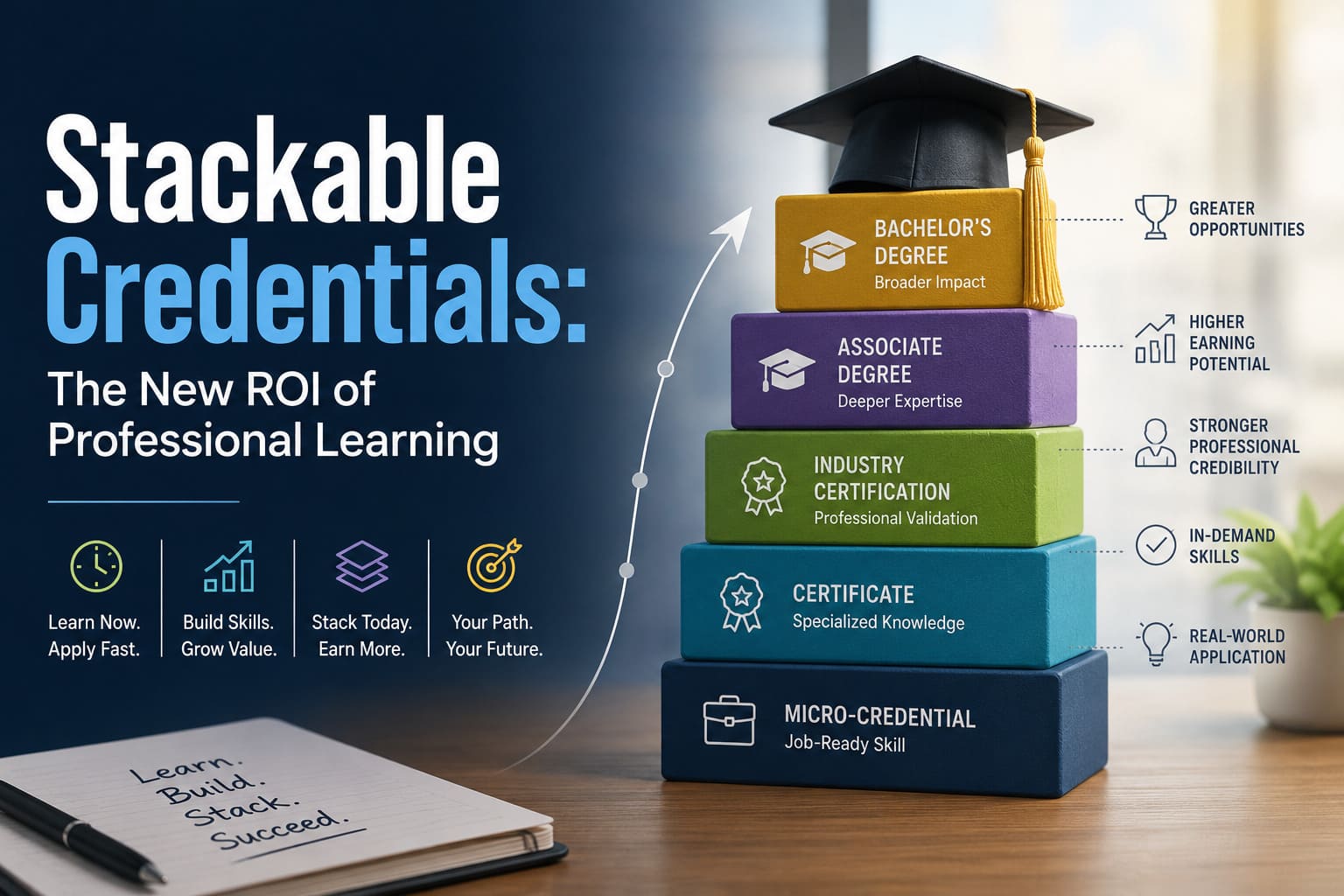
For a long time, the career advice was simple: get a degree, get a job, you’re set for life. That advice hasn’t aged well. Industries change faster than four-year programs can keep up, and a lot of students — and the parents helping fund their education — are asking a more practical question: is one big credential still the smartest way to build a career, or are there better building blocks now?
That’s where stackable credentials come in. They’re not a replacement for a degree, and they’re not a shortcut either. Used well, they’re something more useful: a flexible way to show what you can actually do, one verified step at a time.

Outline
What Are Stackable Credentials, Exactly?
A stackable credential is any short, focused qualification — a certificate, a micro-credential, a digital badge, an industry certification — that’s designed to build toward something bigger. Earn one, and it stands on its own as proof of a specific skill. Earn a few in the right sequence, and they “stack” into a larger qualification, like an associate degree, a bachelor’s degree, or recognized expertise in a field.
There are a few common patterns this takes:
- Progressive (or “traditional”) stacking — a straight line, like earning a certificate, then an associate degree, then a bachelor’s, each one building on the last.
- Supplemental stacking — adding a focused certificate on top of a degree you already have, to specialize further.
- Independent stacking — collecting credentials in a field without necessarily working toward a single degree at the end.
- Work-based stacking — credentials earned through apprenticeships or employer-sponsored training, combining on-the-job learning with formal recognition.
The common thread: you don’t have to commit to one long, all-or-nothing program to start building real, recognized qualifications.
What This Looks Like in Real Life
The concept is easier to picture with examples:
- Harvard Extension School lets students start with a two-course microcertificate, build it into a full graduate certificate, and eventually apply that work toward a master’s degree — without recommitting from scratch at each stage.
- Google Career Certificates offer focused, several-month programs in fields like IT support or data analytics, aimed at people moving into a new field without a traditional four-year run-up.
- Microsoft’s certification tracks let IT professionals build from foundational credentials up to advanced, specialized ones as their career grows.
- CrossFit’s coaching credentials work the same way outside the tech and business world — Level 1 through Level 4, each one a recognized step toward the next.
Different fields, same idea: smaller, verifiable wins that add up.
Do Stackable Credentials Actually Pay Off?
This is the part worth being honest about. You’ll find plenty of headlines online promising dramatic salary jumps from a single certificate. Most of those numbers don’t hold up to scrutiny — they’re often pulled from one specific success story (someone changing careers entirely) and presented as if it’s the typical outcome.
The real, sourced data is more modest — and more trustworthy because of it:
- Coursera’s 2026 Micro-Credentials Impact Report, based on a global survey of more than 3,500 learners and employers, found that 94% of employers are willing to offer higher starting salaries to candidates with micro-credentials — and among graduates with credit-bearing credentials specifically, 82% reported salary increases of 10% or more.
- Several independent industry surveys converge on a similar picture: roughly 28% of professionals report receiving a pay raise after completing a micro-credential, and the Lumina Foundation’s own research found about 1 in 3 entry-level employees credited a recent raise to one.
- Research from Brown University, cited by the workforce-education group PLTW, found that adults who pursued a stackable-credential pathway were about 4% more likely to be employed and earned roughly 7% more than peers who didn’t.
That’s a real, measurable advantage — just not a guaranteed windfall. Treat any source promising a fixed, dramatic salary jump (40%, 50%, double your income) as a flag to dig deeper into where that number actually came from before trusting it.

How to Spot a Credential Worth Your Time
Not every certificate is created equal, and the credentials market has grown fast enough that quality varies a lot. A few questions worth asking before committing time or money to one: